

50 YEARS OF THE KASSÁK MUSEUM
Half a century ago, on 26 November 1976, the Kassák Museum opened its first exhibition. Established as a branch of the Petőfi Literary Museum, it was founded on the estate handed ower by Klára Kárpáti, widow of Lajos Kassák, who died in 1967. It found its home in the Zichy Castle in Óbuda, which had just been renovated and freed from more than a century of military use. Kassák and his wife spent the last decades of their lives in Óbuda, so it was understandable that Kassák’s oeuvre, otherwise more closely associated with the workers’ districts of the Pest side of the Hungarian capital, found a museum home here. For this installation marking the fiftieth anniversary of the museum’s opening, we have selected from the photographs of the opening and interiors of our first permanent exhibition, as well as from the press articles published at the time of the museum’s foundation and opening.
The Kassák Museum’s first permanent exhibition ran from 1976 to 2007 and was curated by our founding director, Ferenc Csaplár. The display occupied a considerably larger space than the current permanent exhibition, which reopened in 2011, as it was in those three rooms that now house the museum’s offices and storages. The exhibition focused on Kassák’s life and art, presenting the manuscripts, photographs, publications, relics and artworks held in the museum’s collection in wall cases arranged chronologically.
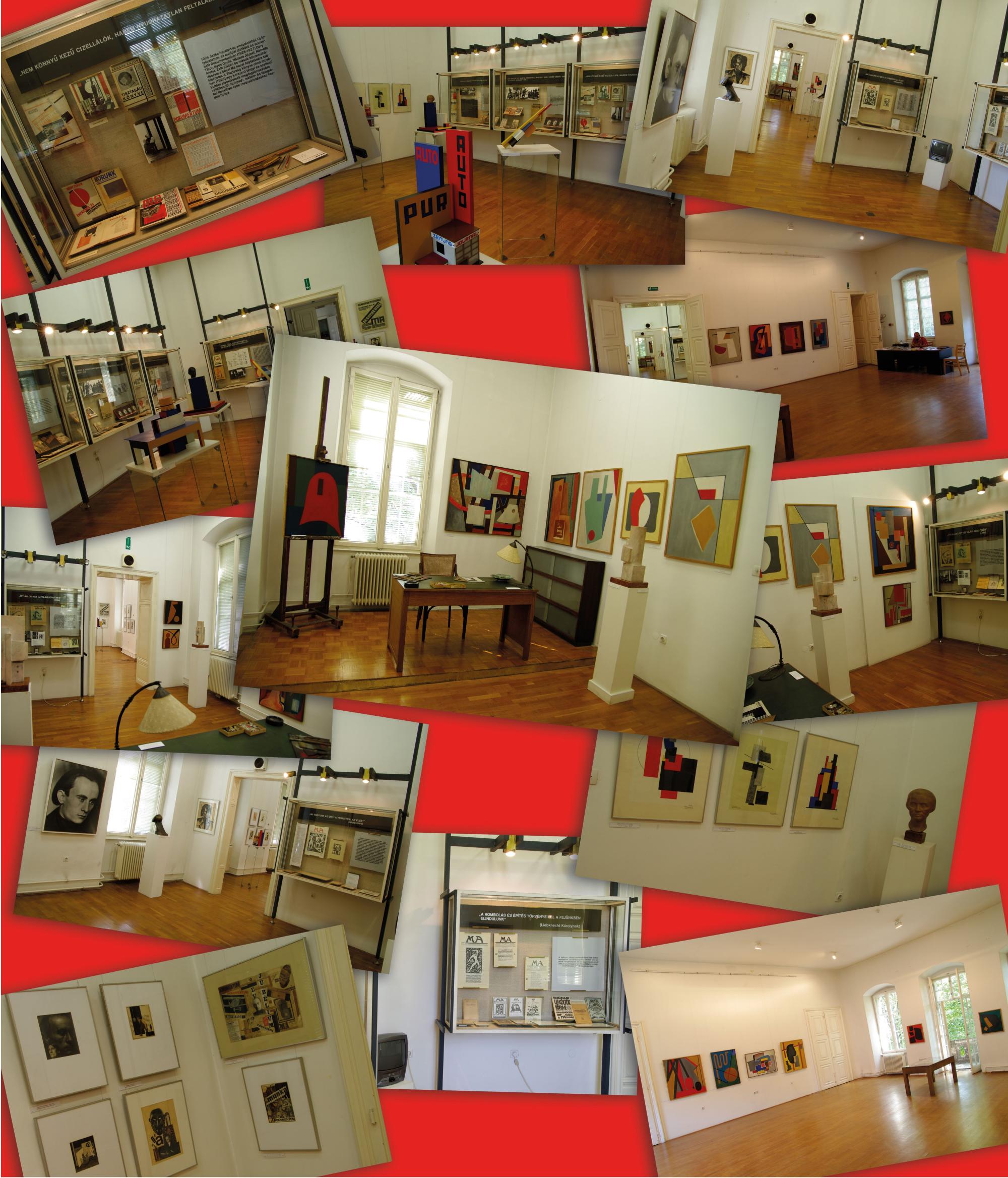
The exhibition centred on Kassák’s avant-garde period: the decades in which, through his openly left-wing literary and artistic movement and his periodicals, he was present not only in Hungarian but also in European artistic life. The period after the Second World War, described in the terminology of state socialism as the “post-liberation” era, was covered only in broad outline; in its place, the exhibition reconstructed Kassák’s former study and workshop in his Óbuda apartment as an interior. The rooms also contained many of Kassák’s paintings, as well as sculptures, among them Attila Joláthy’s colourful models, made after Kassák’s designs for advertising kiosks.
Alongside the permanent exhibition, Csaplár also organised temporary exhibitions. At first there was only one per year, but later, from the late 1990s and through the 2000s, the museum opened a new exhibition every two to three months. As can also be seen in the present installation, from its foundation the Kassák Museum’s temporary exhibitions went beyond the person and oeuvre of Lajos Kassák, aiming to present the Hungarian literary and visual-arts avant-garde movement as a whole. This legacy was continued by the three directors who followed Csaplár: Gábor Andrási, Edit Sasvári and Merse Pál Szeredi. We hope that 2027, the 140th anniversary of Kassák’s birth and the 60th of his death, will offer an opportunity for the Kassák Museum to greet its visitors once again with a new permanent exhibition. Until then, we are temporarily reviving, as a journey back in time, the previous exhibition that opened fifty years ago.
